
# Inside the Operator System Fixing AI Agent Performance
The terminal window sits open, a cursor blinking with the patient indifference of a machine. You type a command, and for a moment, the AI agent—perhaps Claude Code, perhaps Cursor, perhaps a custom-built harness—springs into life. It begins to scan your repository, refactoring functions and chasing down bugs with a speed that feels like a superpower. But then, the inevitable happens. The agent loses the thread. It forgets a crucial architectural constraint discussed ten minutes ago. It burns through ten thousand tokens repeating a failed test. In the worst-case scenario, it hallucinates a flag and executes a command that wipes a directory.
This is the "Agentic Fog," the point where the promise of automated development hits the hard ceiling of current LLM limitations. We are currently living through a gold rush of agentic tools, but we are also discovering that an LLM in a terminal is not, by itself, a developer. It is an engine without a chassis.
Enter affaan-m/everything-claude-code, or ECC. What began as a hackathon-winning project has rapidly ballooned into a viral infrastructure layer, amassing over 182,000 stars on GitHub. It is a staggering number that signals a collective realization within the developer community: if we are going to let agents write our software, we need more than just a better model. We need an operator system.
The Middleware of Autonomy
To understand ECC, one must first understand the "harness." In the current ecosystem, a harness is the interface that wraps an LLM—tools like Zed, GitHub Copilot, or the newly released Claude Code. These tools provide the connection to the file system and the terminal, but they are often philosophically "thin." They provide the hands, but they don't provide the professional habits.
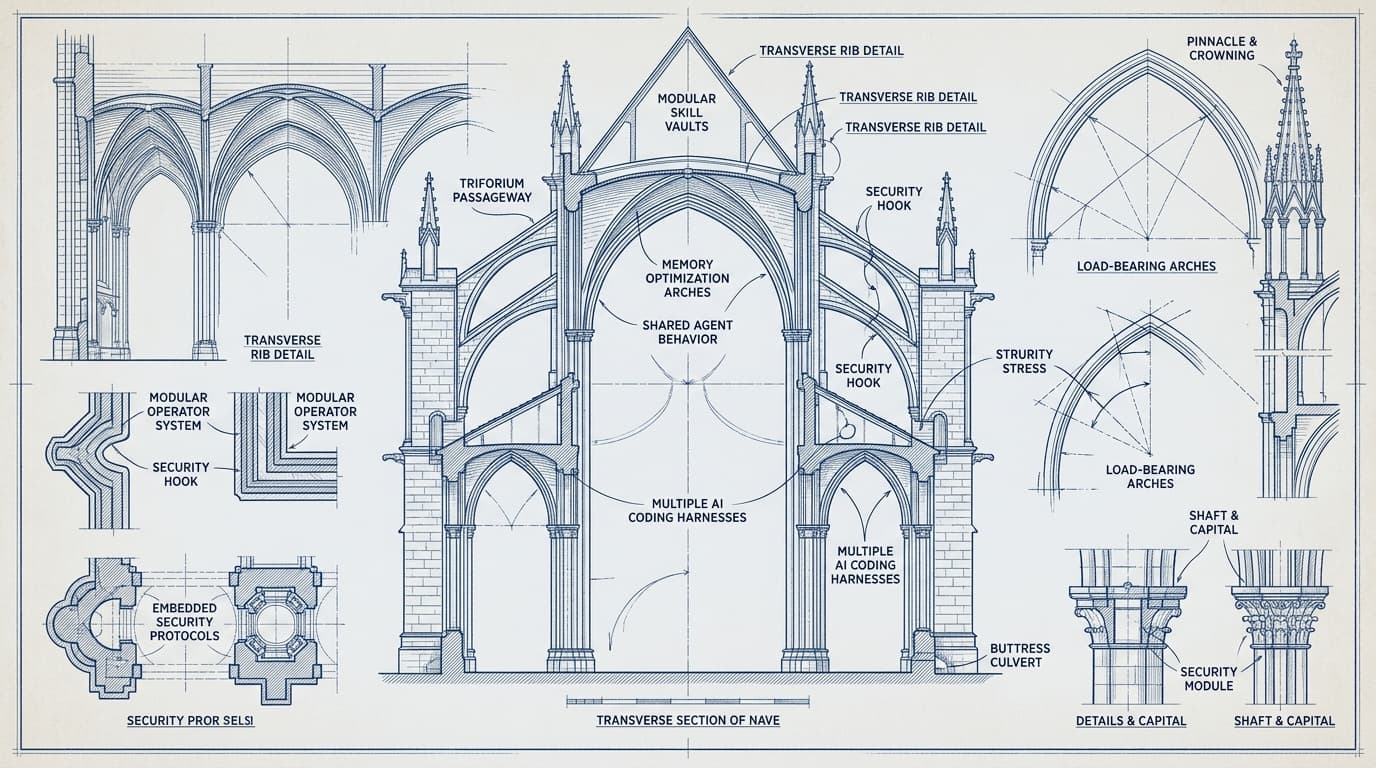
ECC functions as a modular operator system that sits between the developer, the harness, and the underlying model. It is designed to solve the fragmentation problem. Currently, if you switch from Cursor to Claude Code, you lose your "contextual momentum." Your custom rules, your preferred patterns, and your security guardrails have to be rebuilt from scratch. ECC aims to standardize this behavior through a shared architecture of skills, memory optimization, and security hooks.
At its core, the project is built on the premise that agentic work is a repetitive, high-entropy process that requires a structured environment to remain performant. The repository provides what the creator calls "harness-native" optimizations. This isn't just a collection of .clauderc or .cursorrules files. It is a sophisticated suite of JavaScript and TypeScript packages, including ecc-universal and ecc-agentshield, designed to inject a set of "instincts" into the agent.
One of the most compelling architectural decisions in ECC is the move toward "memory persistence." In a standard agentic session, the model’s memory is ephemeral; it exists only within the context window of the current conversation. When that window fills up, performance degrades, and the agent begins to "forget" the beginning of the task. ECC implements hooks that automatically save and load context across sessions. It treats the agent’s memory not as a temporary buffer, but as a long-term asset that can be indexed and retrieved. This is achieved through an iterative retrieval pattern that allows subagents to pull in only the relevant "digital scar tissue" from previous sessions, keeping the primary context window lean and focused.
The Security of the Shell
The most significant barrier to the widespread adoption of AI agents in production environments isn't intelligence—it's trust. When you give an agent the ability to execute shell commands, you are essentially handing the keys to your machine to a probabilistic engine. The risk of a "hallucinated command" or a prompt injection attack is not theoretical; it is a fundamental vulnerability of the medium.
ECC addresses this through AgentShield, a security scanning and sanitization layer. Instead of allowing the agent to communicate directly with the shell, AgentShield acts as a programmable filter. It can intercept commands, scan for known attack vectors, and enforce sandboxing rules. This is the "security-first" development philosophy that the repository champions. It recognizes that for an agent to be truly useful, it must be "governed."
The project’s "Security Guide" outlines a sophisticated approach to these risks, covering everything from CVE scanning to the sanitization of model-generated scripts. By providing a standardized way to handle these hooks across multiple harnesses, ECC allows teams to set a global security policy that follows the developer, regardless of which AI tool they happen to be using that day.
This governance extends to what the project calls "Verification Loops." Rather than simply trusting the agent’s output, ECC encourages the use of grader types and "pass@k" metrics. It builds a structure where the agent’s work is continuously evaluated against a set of evolving benchmarks. This creates a feedback loop where the system learns from its own successes and failures—a process ECC calls "Continuous Learning." It automatically extracts patterns from successful sessions and turns them into reusable "skills" that the agent can call upon in the future.

The Shift to Agentic Infrastructure
ECC is not a tool for the casual user. It is built for the "technical literati"—developers who are already integrating agents into their daily workflows and are hitting the limits of the "out-of-the-box" experience. It is for the engineer who wants to optimize their token usage by slimming down system prompts, or the team lead who needs to ensure that every agent-generated PR has been audited by a specific set of rules via the ECC GitHub App.
The project’s recent v2.0-rc.1 release introduces the "Hermes" operator story, a cross-harness architecture that further abstracts the agent's logic from the specific tool being used. In the codebase, you can see the granular attention to detail required to make this work. For instance, recent commits show fixes for writeBridgeAtomic to handle file system edge cases on Windows, such as EPERM and EBUSY errors during rename operations. This is the unglamorous, "plumbing" level of engineering that is required to make agentic tools reliable in a professional setting.
What does the viral success of ECC tell us about the future of software development? It suggests that we are moving away from the era of "AI as a feature" and into the era of "Agentic Infrastructure." We are realizing that the model is just the beginning. The real challenge—and the real value—lies in the layer that manages the model's behavior, protects the system from its mistakes, and preserves its knowledge over time.
"Not just configs. A complete system: skills, instincts, memory optimization, continuous learning, security scanning, and research-first development."
This quote from the ECC README captures the shift. We are no longer just "chatting" with code; we are operating a complex, autonomous system. As these agents become more capable, the "operator system" will become as essential as the compiler or the version control system.
The existence of a project like ECC proves that the community is not waiting for the big labs to solve the "agent problem." Instead, developers are building the middleware themselves, creating a decentralized standard for how an AI should behave when it's given a terminal. It is a signal that the future of coding isn't just about better models—it's about better systems for those models to live in. If the 182,000 stars are any indication, the industry is more than ready to stop fighting the "Agentic Fog" and start building the lighthouse.



![dependabot[bot]](https://avatars.githubusercontent.com/in/29110?v=4)


