
# How Anthropic Is Standardizing AI Agent Capabilities at Scale
The moment an AI agent needs to generate a PowerPoint presentation that matches your company's brand guidelines, something interesting happens. The model itself hasn't changed. The training data hasn't been updated. But somehow, the agent knows exactly which fonts to use, which slide layouts to prefer, and how to structure the deck in a way that would pass muster in your Tuesday all-hands. That gap — between raw model capability and domain-specific execution — is the problem anthropics/skills was built to close.
The repository, which crossed 108,000 stars with unusual speed, is deceptively simple in its interface and architecturally deliberate in its implications. It's the official home of Anthropic's Agent Skills system, and it contains something that doesn't get enough attention: the actual source code powering Claude's native document generation capabilities for DOCX, PDF, PPTX, and XLSX files. That alone makes it worth understanding.
The Problem With Prompting Everything
For years, the dominant approach to specializing an AI model's behavior has been the system prompt — a blob of instructions prepended to every conversation that tells the model who it is, what it knows, and how it should behave. This works, up to a point. But system prompts are monolithic. They don't compose well. They can't carry scripts, assets, or structured resources alongside them. And as enterprises started building agents for increasingly specific workflows, the limitations became structural rather than just inconvenient.
Imagine equipping an agent to handle three distinct tasks: analyzing data using your organization's internal methodology, generating communications in your brand voice, and automating a specific DevOps workflow. A single system prompt trying to handle all three becomes bloated, context-window-hungry, and difficult to maintain. More importantly, it treats specialization as a one-time configuration problem rather than what it actually is: a capability that should be modular, portable, and composable.
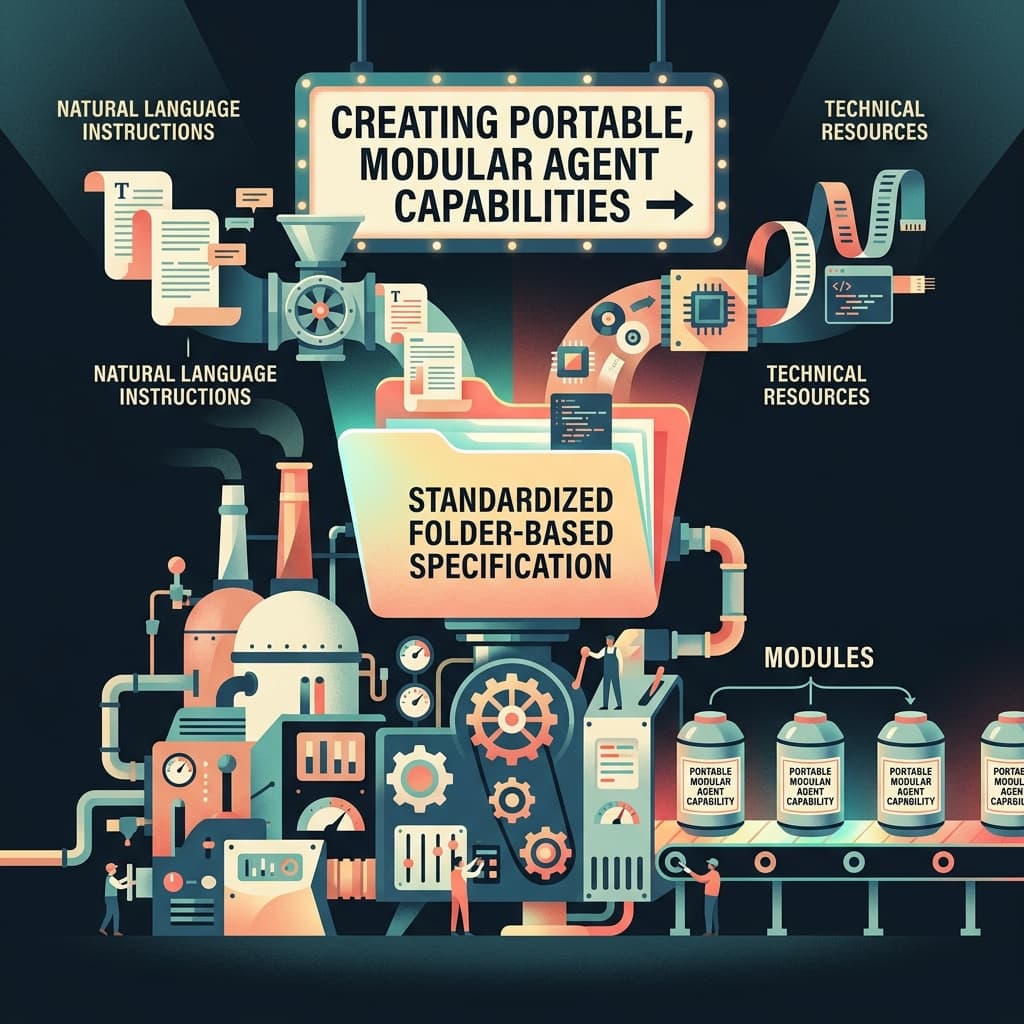
That's the design premise behind skills. Rather than cramming everything into a prompt, skills are folders — self-contained units that bundle natural language instructions with whatever technical resources those instructions depend on. Scripts, templates, metadata, examples: all of it lives together in a directory, anchored by a SKILL.md file.
Skills are folders of instructions, scripts, and resources that Claude loads dynamically to improve performance on specialized tasks.
The SKILL.md format is worth examining closely because its simplicity is doing a lot of work. YAML frontmatter provides structured metadata — a name and a description are the only required fields — while the markdown body below contains the actual instructions the agent follows. That's it. The spec is minimal enough that a developer can write a functional skill in under ten minutes, but expressive enough to encode genuinely complex workflows.
Architecture by Convention
What makes the folder-based approach interesting isn't just that it's clean — it's that it enforces a philosophy. By making each skill a discrete directory, the system creates a natural unit of distribution, versioning, and composition. You can install a skill from a marketplace. You can version-control it independently. You can swap one implementation for another without touching anything else in your stack.
The repository itself demonstrates this philosophy at multiple levels of complexity. The skills/ directory contains dozens of examples spanning creative applications, developer tooling, and enterprise communication workflows. These range from lightweight skills with nothing but a SKILL.md to more complex ones that include supporting scripts and assets. Browsing through them feels less like reading documentation and more like studying a pattern library.
The document skills — skills/docx, skills/pdf, skills/pptx, and skills/xlsx — represent the opposite end of the complexity spectrum. Anthropic has made these source-available (not open source under Apache 2.0, but deliberately shared for reference) because they're production code running at scale inside Claude.ai's document generation features. Looking at them reveals what a mature, production-hardened skill actually looks like: layered instructions, careful error handling guidance, and the kind of specificity that comes from real-world usage rather than theoretical design.
The Claude Code integration is particularly telling about where this system fits in the broader developer workflow. A single command — /plugin marketplace add anthropics/skills — registers the entire repository as an installable marketplace. From there, installing the document skills is as straightforward as /plugin install document-skills@anthropic-agent-skills. The agent then responds to natural language: "Use the PDF skill to extract the form fields from path/to/some-file.pdf" Just mention the skill, state the task.
This is the underappreciated power of the description field in the YAML frontmatter. Because the agent uses that description to understand when a skill is relevant, a well-written description functions as a routing mechanism — the difference between an agent that uses the right tool and one that blunders through a task with only its base training.
Who This Is For and What They Can Build
The immediate audience is developers building Claude-powered applications who want repeatable, specialized behavior without re-engineering their prompts every time requirements change. A team maintaining a legal document workflow can encode their specific templates and formatting rules into a skill, check it into their repository, and deploy it alongside their application code like any other artifact.
But the partner integrations point toward a broader use case. Notion has already published skills that teach Claude how to work with their platform — essentially encoding platform-specific knowledge into a portable, shareable format. This is the beginning of an ecosystem: third-party software vendors distributing skills the way they currently distribute SDKs, except these don't require code changes in the calling application. The agent just gets smarter about a particular tool.
Enterprise teams have an equally compelling use case. The README explicitly calls out brand guidelines, organizational workflows, and personal automation as target applications. A skill containing your company's communication style guide, preferred document structures, and approved terminology effectively turns that institutional knowledge into something an agent can load and apply consistently — across teams, tools, and time.
What This Tells Us About Where Agents Are Heading
The existence of a specification (./spec) and a companion website at agentskills.io signals something more than a product feature. Anthropic is making a bet that skills, or something like them, will become a standard interface layer between AI agents and domain knowledge — the way HTTP became a standard interface layer between clients and servers.
The bet is that the hard problem of deploying AI agents at scale isn't the model. The model is increasingly capable and increasingly cheap. The hard problem is knowledge management: how do you get the right contextual knowledge to the right agent at the right time, in a form that's maintainable, auditable, and composable? A folder with a markdown file and a clear spec is a surprisingly elegant answer.
That 108,000-star count didn't accumulate because developers needed another prompt management tool. It accumulated because the skill folder pattern solves a real organizational problem — the same one that Docker solved for application deployment, or npm solved for code reuse. Not by adding more intelligence to the agent, but by giving that intelligence a reliable, portable container.


![cc-skill-sync[bot]](https://avatars.githubusercontent.com/u/76263028?v=4)


